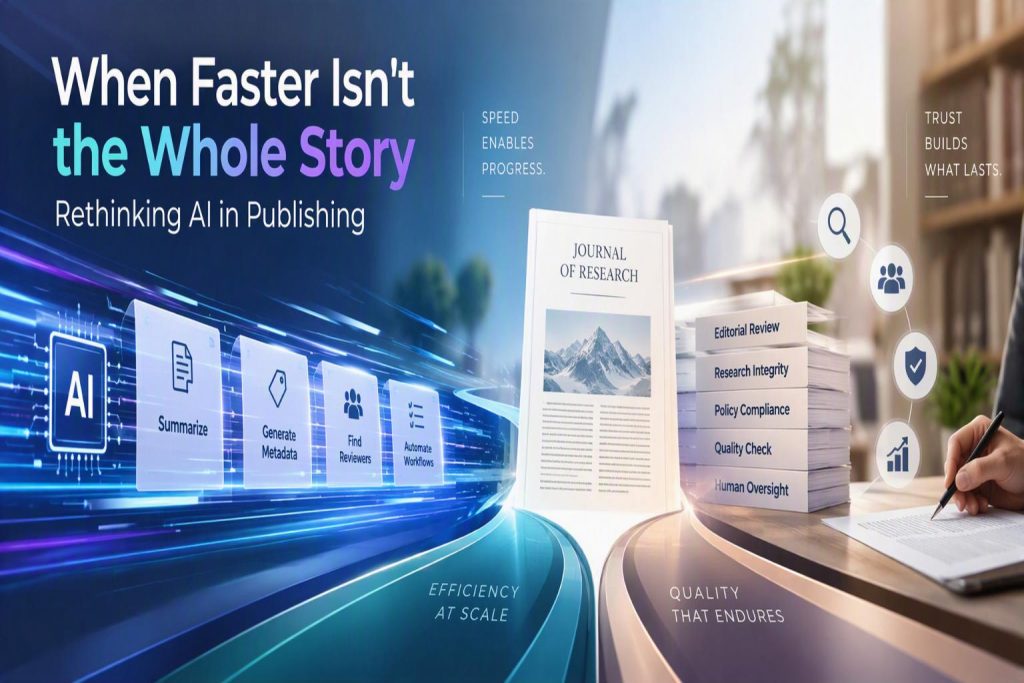
For decades, publishers have worked toward one goal, which is reducing friction from the publishing process. Faster submission process. Faster peer review. Faster decisions. Now, artificial intelligence (AI) promises to further reduce friction. Tasks that need editorial teams to spend hours are now done by AI within seconds. From summarizing manuscripts, generating metadata, finding reviewers, and a lot more, AI can take on time-intensive tasks, and improve speed and efficiency. This leads to an obvious assumption: publishing should become significantly faster.
But the real question is: Are all delays in publishing problems that need to be solved?
Efficiency can be boosted if friction is reduced, but what if some friction is necessary? AI is transforming the way research is being created and disseminated. So maybe the real challenge lies in deciding which forms of friction should be removed, and which ones should be retained. Afterall, the ultimate goal of publishers is to build confidence in published works.
With every passing year, the volume of submissions is multiplying. Authors, universities, and funders expect research to go from submission to publication as quickly as possible. So, the requirement for speedy publishing is real. But has publishing ever been solely about the speed of output?
Every published article expands the horizon of knowledge and becomes the foundation of future research. So, publishers hold the responsibility of ensuring that the quality and integrity of publication is maintained. Shortening the timelines of publishing may not be the only objective for publishers to adopt AI. While they need to publish at scale, they also need to do this responsibly.
It may seem that some activities such as editorial review, research integrity checks, and policy compliance slow down workflows. However, they serve an essential purpose of preventing questionable research from getting published. In this context, some forms of friction are not barriers to progress. They help to build trust in the published record.
Often, discussions around AI and speed fail to consider that technology often helps with individual tasks rather than workflows. AI can perform brilliantly at the task level, and publishers are already integrating this into the publishing lifecycle. A AI survey conducted by the Society for Scholarly Publishing found that workflow efficiency and time savings were the most widely recognized opportunities associated with AI adoption in publishing.
The same survey revealed that publishers expressed concerns around quality, ethics, legal considerations, and organizational readiness. This tension raises some important questions: Should the impact of AI on publication be measured by speed alone? And does speedy publishing mean progress?
Publishing depends on a combination of technology and human oversight. As a result, faster completion of tasks may not translate into faster publication. But does that mean AI doesn’t deliver value? No. It brings to light how complex publishing is.
AI can bring consistency and reduce administrative burden. This means editorial teams would be able to focus on tasks that are tough to automate, such as building communities, supporting reviewers, and strengthening integrity practices. AI, therefore, can contribute to a lot more than speed. Its real value may not lie in cutting out human involvement. It can offer more opportunities for humans to contribute where it matters most.
On their part, publishers are taking steps to create transparent and trustworthy processes. This shift is reflected in recent work by the STM Association where recommendations were developed for the classification and disclosure of AI use in manuscript preparation. Such initiatives indicate that publishers are looking beyond taking content from submission to publication. They are looking to establish confidence in the research that gets published.
AI technologies are rapidly gaining capability and are getting embedded in every aspect of scholarly publishing. In such a situation, publishers may not be pursuing the goal of removing all friction. They would need to determine which forms of friction make the publication process more transparent and trustworthy. This will ensure that published research remains credible in the long term. The future of publishing, therefore, depends on the ability of publishers to balance scale and speed.
…………………………………………………………………………………………………………………..