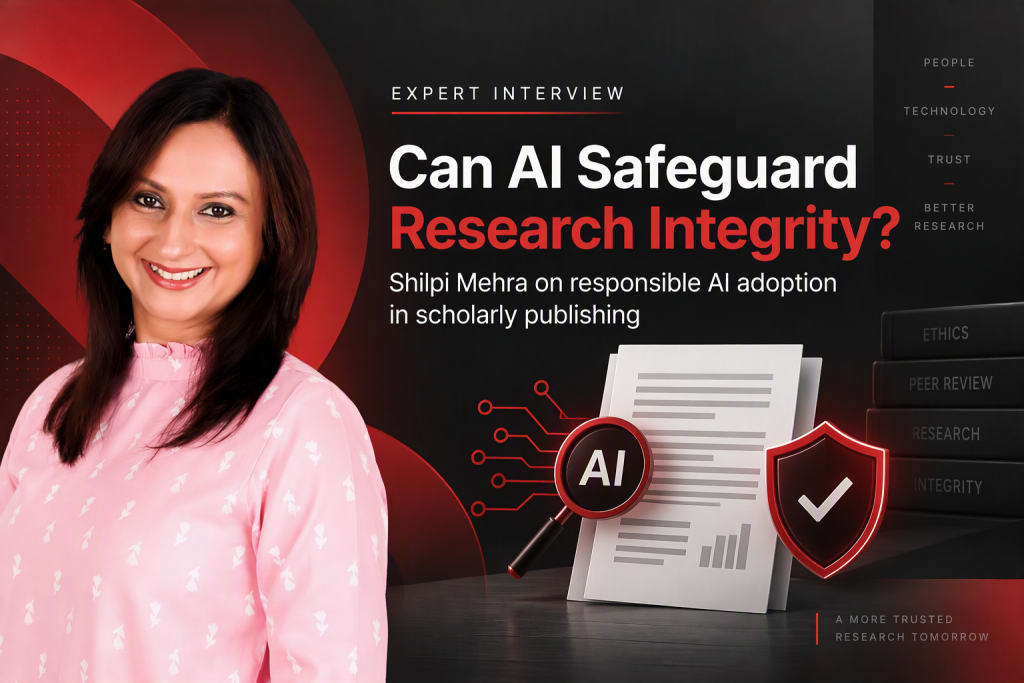
Is AI a threat to research integrity, or could it become one of its most powerful safeguards? In this interview, Shilpi Mehra, Associate Vice President, Product, at CACTUS, discusses the evolving integrity challenges publishers are facing and the role AI can play in identifying risks at scale. She also shares insights on why building trust in research will require human judgment alongside technology.
Many discussions position AI and research integrity as opposing forces. Do you think that’s an accurate framing, or is the reality more nuanced?
It’s not as black and white as that. AI is just a tool, and it depends on who is using it and why. Yes, it has made it much easier for paper mills to produce manuscripts that look genuine and for authors to introduce “little white lies” into their work. But we’re also using it to screen huge numbers of submissions for things like fabricated text, citation manipulation, and image plagiarism, which would take people weeks to do by hand. So, I don’t see them as opposing forces. I feel the bigger question is whether the people protecting research are keeping pace with the people trying to game it.
Research integrity has been a concern long before generative AI. What has changed for publishers in recent years, and what challenges are becoming harder to manage?
Integrity problems have been around forever. When I was heading Publication Support Services at CACTUS, researchers would sometimes openly ask us to write up their data into a manuscript for them or give us a starting point and ask us to ‘create’ the research. We explained why it was unethical and detrimental to them and science. Now they don’t need to ask anyone; they can just use an LLM.
The pressure to publish hasn’t gone anywhere; it has just become easier and cheaper to act on. Paper mills exist because there is demand for what they sell. What’s harder for publishers now is the sheer volume, and the fact that problematic papers don’t look obviously bad anymore. The usual red flags are much harder to spot.
As submission volumes grow, publishers are increasingly using AI to detect potential issues. Where do you see AI adding the most value today? And where does it fall short?
I think AI is most useful as a first check across every submission. It can pick up manipulated references, plagiarized images, unusual statistics, or text that has been reworded to get past plagiarism checks. It does this consistently and at high speed, which is hard for people to do at scale.
I saw why this matters a few years ago. We were helping a Chinese author submit to an Elsevier journal and he came back a week later with a rejection saying his paper was already under review with another Elsevier journal. When we looked into it, we found his whole manuscript for sale on a paper-mill website, with author slots priced separately. He had used a free online translation tool before coming to us, and his paper had been stolen and submitted by someone else before he could. That experience made me realise how vulnerable honest authors can be, and it’s one of the reasons I wanted to work on tools that help catch these problems earlier.
One of the areas where AI falls short is context. It can tell you something looks unusual, but not why. Paper mills keep changing their tactics, so new types of misconduct can slip through until the tools catch up. It can also produce false positives, which can be really unfair to genuine authors, especially those writing in a second language. That’s why I see AI as something that helps editors decide when and where to look more closely, rather than something that makes the decision for them.
If an AI tool flags a manuscript as potentially problematic, what role should humans play in the decision-making process? Where does human expertise become essential?
The final decision should always be with a person. AI can find a duplicated image, but it can’t tell whether that was an honest mistake, a co-author who didn’t know what was going on, or someone acting out of a personal grudge. Working that out often means going back to the authors, asking for raw data, or looking at their previous work, and those things need human judgement and experience.
It’s also about accountability. If a paper is flagged, someone should be able to explain why, and stand behind the decision. Authors deserve that. I see an AI flag as the start of a conversation, not the outcome.
Looking ahead, what will distinguish publishers that use AI effectively for research integrity from those that simply deploy AI tools?
I think the publishers who use AI most effectively are the ones who accept that one size doesn’t fit all when it comes to integrity checks.
Screening thousands of new submissions, investigating an integrity allegation and auditing a published article are very different tasks, and they need different things from a tool. An investigation or audit needs depth and detail on a single paper. Screening at scale needs a system to sort manuscripts based on integrity risk depending on the kind of issues found, and in the context of the subject area, article type and journal priorities, so editors know where to focus.
At that scale, every tool will have some false positives and false negatives, and that’s to be expected. It’s the same with people. Even the most experienced reviewers can’t be 100% accurate, and for many routine checks, AI tools perform just as well, if not better, and they scale far more easily.
So, the more useful question isn’t whether each check is perfect, but whether the tool is helping editors find the right manuscripts to look at.
Publishers who understand this are choosing the right tools and checks for each task, rather than expecting one off-the-shelf solution to do everything. They are also working with others in the industry, through organizations like the STM Integrity Hub and United2Act, because paper mills don’t just target one publisher.
What I’d really like to see is integrity checks fitting so naturally into the publishing process that they become as routine and unnoticed as spellcheck is today… something we rely on without thinking about it, while still knowing when to overrule it.
Thank you, Shilpi, for sharing your insights and perspectives on this important topic.
Smarter integrity screening starts with the right balance of AI and human oversight.
Explore Preflight, CACTUS’s hybrid human-AI research integrity solution, designed to help publishers identify potential risks earlier and prioritize high-risk submissions efficiently.