Introduction
Academic publishing is currently sitting at a crossroads: research output is accelerating, consumption patterns are shortening, and discoverability battles are intensifying. In this environment, text impact alone is no longer sufficient, attention is the real citation currency. For publishers, journals, and academic societies, the next competitive frontier is not just producing credible research, but translating it into formats that travel faster, communicate clearer, and engage wider.
Understanding the Core Challenge
Unlike blogs or standard marketing collateral, academic papers are multi-modal artifacts—they contain structured text, complex charts, reference-dense sections, and domain-specific imagery embedded in non-uniform layouts. Traditional AI generation models have advanced significantly in text, image, audio, and video outputs, but long-form document-to-video transformation remains a fragmented problem, largely due to the lack of standardized input formats across academic publishing PDFs and XML-converted paper exports.
This gap amplifies operational friction for publishing teams that aim to scale video-based research storytelling without expanding production bandwidth or costs.
What fails, and how do we avoid it?
Before selecting a video automation workflow, organizations must align on the five pillars of content success in academia—each highlighting what breaks when done incorrectly and how to prevent it:
- Research Fidelity — Does the video preserve the paper’s core insights without distortion, or does simplification introduce misinterpretation risks that can lead to reputational damage or downstream citation errors?
- Author Authenticity — Can the content be validated by the original authors before dissemination, or does lack of author oversight create pushback, disavowals, or refusal to promote the work?
- Time-to-Publish — Can videos be produced fast enough to complement publication cycles, or do delays reduce relevance, discoverability, and overall impact?
- Personalization Depth — Does the format support evolving personalization needs, or does a one-size-fits-all approach limit engagement across audiences such as researchers, clinicians, and policymakers?
- Scalability Reliability — Can the workflow handle thousands of papers without unpredictable failure loops, quality variance, or operational breakdowns that increase correction or retraction risk?
When it comes to translating research papers into short video formats, good” is too low a bar you need something that’s secure, provable and re-usable. For academic publishers, journals, and societies, content decisions typically fall between two mandates:
Who needs creative freedom?
- Society flagship journals and high-impact publications aiming for visually distinctive, brand-anchored storytelling
- Editorial teams promoting breakthrough or interdisciplinary research
- Key opinion leaders (KOLs) and academic ambassadors who prioritize narrative resonance over template conformity
- Special-edition releases, award-winning papers, or annual society showcases where creative differentiation influences prestige and attention span
For these teams, video is not just a summary—it becomes part of the institution’s intellectual identity. Controlled creativity enables abstract concepts, metaphors, pacing choices, stylistic motion design, and narrative arcs that feel original, making the communication memorable and author centric.
Who needs reliability?
- Publishing operations teams handling large backlogs of papers
- Journals building video libraries for indexing, archives, or SEO discovery engines
- Academic societies sharing recurring proceedings (quarterly releases, conference batches, abstract collections)
- Consortia and institutional research hubs where consistency outweighs individuality
These teams operate under constraints where volume, accuracy, consistency of output, and reproducibility are the core KPIs. For them, unstable creative prompts introduce risk—not just operationally but reputationally. A deterministic or hybrid pipeline guarantees that research meaning is not lost in model randomness.
Decision takeaway:
If the goal is institutional influence and narrative originality: Lean Generative.
If the goal is institutional scale and credibility with predictable outcomes: Lean Hybrid/Deterministic.
Video Type 1: AI Avatar Explainers
Video summaries in academia succeed when a trusted voice carries complex insight. Avatar explainers deliver this missing “human narrative” layer—without requiring production teams to film or edit.
Where it adds the most value:
- Papers supported by author or institutional spokesperson explainers on journal landing pages
- Editorial outreach content used in publisher-to-academic engagement
- Society communications and KOL-led distribution that demand authority + personality
- Consultant or subject-matter briefs translating research for academic stakeholders
- Publisher promotions that communicate significance, not visuals alone
When to Use AI Avatar Explainers:
✔ When trust is the asset, not animation
✔ When research needs a recognizable, validating voice
✔ When societies/journals want to avoid stock anonymity
✔ When author affiliation should feel personal and credible
Designed for authority-first academic platforms, community publishing, and publisher outreach. In academia, personal is persuasive—because influence is built on familiar voices and trusted messengers.
Video Type 2: Research Story Slideshows
If avatar explainers personalize influence, slideshows institutionalize it. This format transforms papers into consistent, theme-stable video summaries that publishing teams can scale without structural chaos.
Where it adds the most value:
- Conference proceedings and batched abstract releases
- Publisher-managed research archives and eLibraries
- Academic society knowledge hubs and partner portals
- Thematic journal collections needing uniform narrative design
- Editorial onboarding, compliance training, and internal review libraries
When to Use Research Story Slideshows:
✔ When consistency matters more than visual variance
✔ When content needs to fit existing publishing structure
✔ When teams plan for batch output with low friction
✔ When meaning must remain unchanged across paper volumes
Designed for publish-fast academic cycles, repository indexing, and editorial workflows. Scalability does not demand simplicity—it demands a template that behaves like truth.
Video Type 3: Kinetic Text + Stock Footage
While slideshows scale institutional knowledge internally, kinetic text videos scale research attention externally. This motion-first format turns key insights into high-velocity awareness assets that still feel academically credible.
Where it adds the most value:
- YouTube Shorts managed by journals
- Publisher-run topic-based awareness campaigns
- Newsletter research trailers to drive paper discovery
- Society channels promoting research clusters
- Academic storytelling aimed at attention velocity over narration
When to Use Kinetic Text Videos:
✔ When visibility matters more than voice
✔ When messaging must be fast, repeat-watch friendly
✔ When teams want minimal narration dependencies
✔ When distribution is built for reach, recall, and organic discovery
Designed for research promotion that moves at platform speed but reads like academia. Text that moves, travels. Text that travels, amplifies.
Video Type 4 & 5: Premium AI Reels vs Loop Animations
Research communication needs two delivery depths—Influence and Impressions. Premium AI reels build long-form narrative authority, while loop animations create short-form memory hooks for re-impressions.
Where Premium AI Reels add the most value:
- Editor-featured journal spotlights
- Flagship, award-worthy, and high-impact publisher promotions
- Annual society summaries and ambassador-led paper amplification
- Papers needing production-grade narrative gravity
When to Use Premium AI Reels:
✔ When research storytelling must feel flagship-film real
✔ When the video is a stand-alone influence asset
✔ When journals/societies want maximum narrative immersion
Designed for institutional papers that demand spotlight-level storytelling with full AI orchestration.
Where Animated Graphical Abstracts add the most value:
- Publisher-run email newsletters and congress mailers
- The goal is micro-attention recall loops, not long storytelling
- Research snapshots for repeat impressions
- Use cases driven by memory anchoring over storytelling
When to Use Loop Animations:
✔ When retention and recall drive the KPI
✔ When videos must be 10–30 sec loop-friendly
✔ When distribution is designed to be re-seen, not just watched once
Designed for research content that lives in loops, not lectures. Reels build influence. Loops build memory. Publishers need both.
Which Option Should Your Team Choose?
A guiding principle for academic institutions:
- If your priority is credibility + human connection → AI avatar explainers
- If your priority is scale + operational reliability → deterministic hybrid slideshow or kinetic templates
- If your priority is flagship promotional impact → premium AI reels
- If your priority is fast-travel awareness loops → loop animations
Most institutions benefit from a multi-format approach piloted through deterministic pipelines first, preserving fidelity at scale, then upgrading personalization depth in strategic layers.
What connects all formats?
They are not competing outcomes—they are stackable stages of a mature academic distribution workflow:
| Stage | Best Format |
| Influence | AI Avatars → Premium Reels |
| Scale Enablement | Template Slideshows |
| Outreach Velocity | Kinetic Text |
| Recall & Re-impressions | Loop Animations |
Enterprise Recommendation
For institutional publishing stakeholders, the correct roadmap is not experimental—it is enterprise-ready.
- Start with hybrid/deterministic formats
- Create test batches based on 2–3 different published PDF layouts
- Embed structured author oversight checkpoints
- Approve template stability internally
- Expand to journal-level batch automation
- Introduce premium generative layers only for flagship distributions
“Scale first. Personalize second. Go viral strategically, not accidentally”.
What’s Next
‘Publish research that gets cited. Share research that gets watched.’
If your organization is exploring paper-to-video automation Cactus is actively shaping AI workflows for the publishing vertical.
The question isn’t whether publishers should adopt research video automation… it’s which format travels furthest for you.
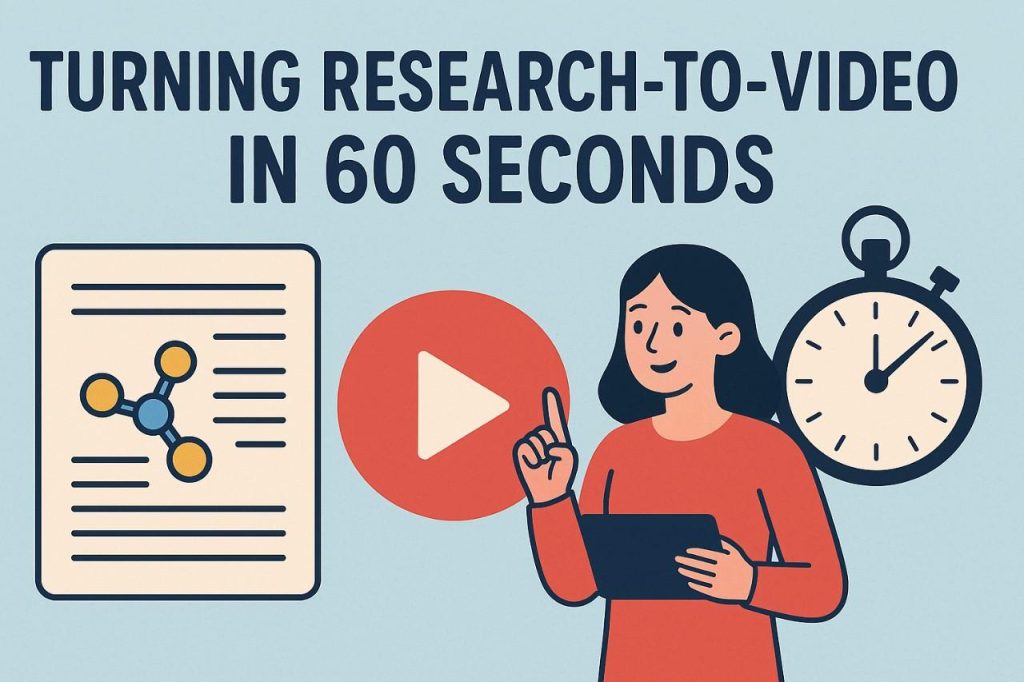
See it, test it, publish it Research-to-video in 60 seconds. Let us show you how. Contact Us